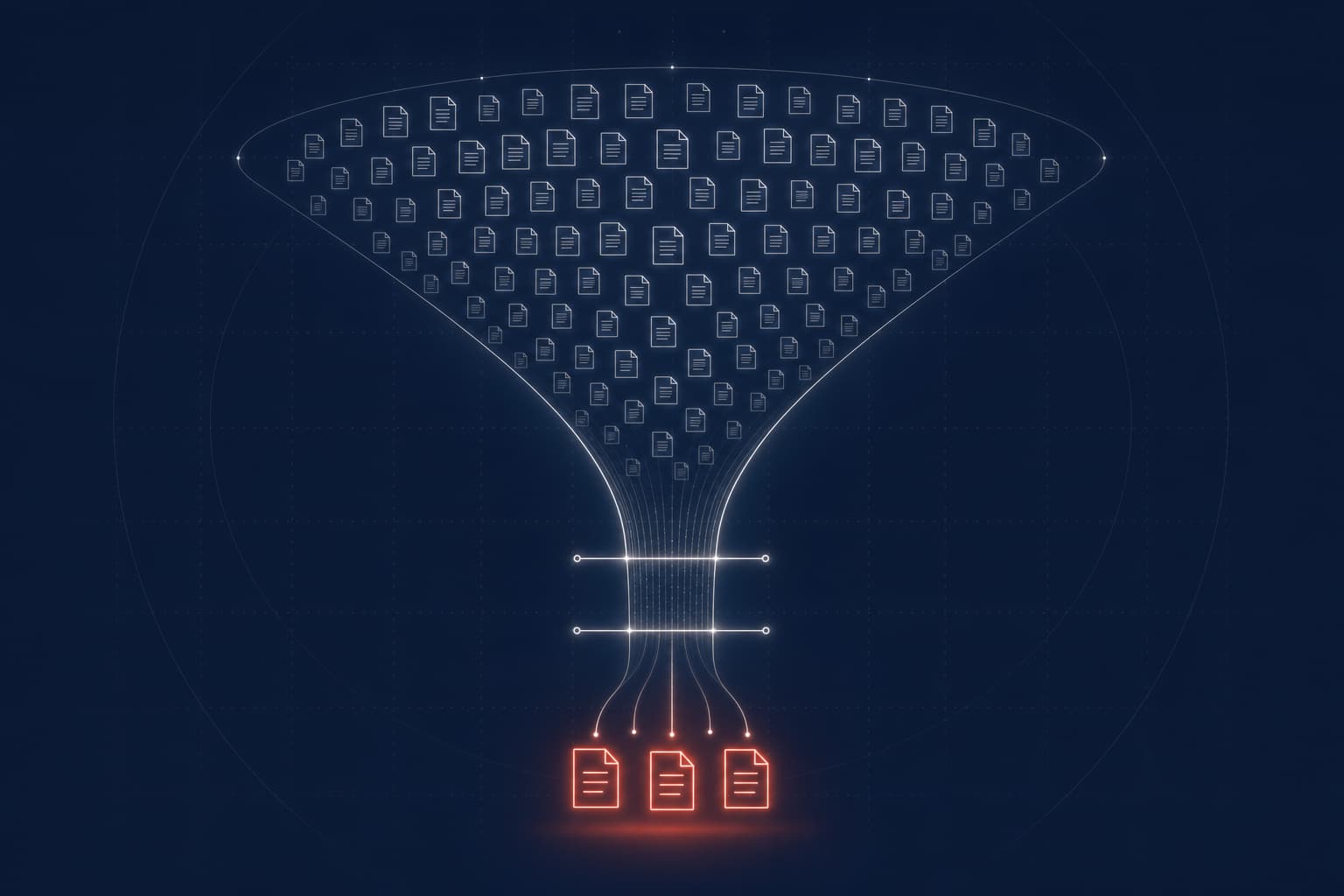
Screening is the stage where thousands of search results are narrowed to the studies that actually meet your review question, in two passes. Our service runs title and abstract screening across the full deduplicated yield, then full text screening of every survivor against your eligibility criteria, with two independent reviewers, a documented conflict-resolution step, a Cohen’s kappa agreement figure, and logged exclusion reasons that feed straight into your PRISMA 2020 flow diagram.
Systematic review screening service
We screen your search results in two stages, with two independent reviewers, a documented conflict step, and a kappa figure, so your PRISMA flow counts are accurate and defensible.
4.9 / 5 across 1,194+ delivered projects
- Cochrane and PRISMA 2020 methods
- PhD methodologists
- 100% human-written, no generative AI
- Reproducible R and Stata code
- Free quote within 24 hours
- Mutual NDA on request
Why screening is where a review is won or lost
Screening is the point at which the boundary of your review is drawn. A study wrongly excluded here never reaches extraction or synthesis, and because that decision leaves no trace in the final dataset, nobody downstream can catch it. That is why screening is judged on process rather than speed: whether two people screened independently, whether they applied the same eligibility criteria, and whether every full text exclusion carries a recorded reason. An editor or examiner will look at your PRISMA numbers and ask exactly these questions, so the rigour has to be built in from the first record, drawing on the principles in our guide to title and abstract screening.
Screening also depends entirely on the criteria it is measured against. Vague or shifting eligibility rules are the usual reason reviewer agreement collapses and conflicts pile up. We settle the inclusion and exclusion criteria before screening starts, and where the literature search and deduplication have produced the record set, screening follows directly from that clean, de-duplicated yield rather than a messy export.
How the two-stage screening works
- 1
Set up and pilot the criteria
We turn your eligibility criteria into a screening form, then pilot it on a sample of records so both reviewers interpret every rule the same way before full screening begins.
- 2
Title and abstract screening
Two reviewers independently screen the full deduplicated yield on title and abstract, keeping any record that could plausibly qualify and excluding only the clearly irrelevant.
- 3
Full text screening
Every record that survives the first pass is read in full by both reviewers against the criteria, with a specific exclusion reason recorded for each paper that does not qualify.
- 4
Reconcile and report
Conflicts are resolved against the criteria with a third reviewer as tie-breaker, agreement is quantified with Cohen's kappa, and the counts are assembled into your PRISMA 2020 flow diagram.
Dual independent reviewing, not one person twice
The value of screening comes from two people applying the same rules separately and then comparing, so a lapse by one reviewer is caught by the other. We screen in duplicate at both stages, keep the two reviewers blind to each other’s calls until reconciliation, and treat disagreement as useful information rather than a nuisance. When the pair cannot agree, a senior reviewer resolves it, and the outcome is logged. This is the process examiners and journals expect, and it is set out in our guides to how many reviewers are needed for screening and resolving screening conflicts.
Agreement is measured, not assumed. We calculate Cohen’s kappa on the double-screened records, report the raw agreement alongside it, and treat a weak value as a signal to tighten the criteria rather than a box to tick. Our guide to inter-rater reliability in screening explains how we report that figure so it stands up to scrutiny.
The tools we screen in
Rayyan
Blind, parallel screening with the two reviewers hidden from each other until conflicts are surfaced for reconciliation.
Covidence
End-to-end screening with a built-in conflict queue and PRISMA counts, ideal for teams already running the review there.
EndNote and deduplication
We clean and deduplicate the export first, so the numbers entering screening are accurate and every duplicate is accounted for.
PRISMA flow counts
Records identified, deduplicated, screened, sought, assessed, and excluded with reasons, tallied ready for the flow diagram.
What you receive
You receive a completed screening decision for every record, a full text exclusion log giving a specific reason for each paper excluded at the second stage, the reviewer-agreement statistics, and the finished counts for your PRISMA flow diagram. The exclusion reasons are the ones a PRISMA 2020 diagram requires, and the included set flows directly into data extraction and coding and then risk of bias assessment. Screening decides which studies enter the review; extraction is a separate stage that pulls the data out of them, so the two are quoted and run distinctly.
- An independent screening decision on every record at both stages
- A full text exclusion log with a specific reason for each excluded paper
- Cohen's kappa and raw agreement for the double-screened records
- A reconciliation log showing how every conflict was resolved
- Completed PRISMA 2020 flow counts ready for the diagram
- The final included study set, ready for data extraction
Who needs screening handled for them
Solo reviewers needing a second screener
Researchers who cannot run a credible dual-reviewer process alone and need an independent second screener at both stages.
Teams facing a large yield
Reviews returning thousands of records that need accurate, documented screening completed without stalling the rest of the project.
Doctoral candidates
Students who need screening decisions and a kappa figure that will hold up when examiners probe how the included set was chosen.
Authors answering reviewers
Teams asked to rescreen, add a second reviewer, or report inter-rater agreement before a manuscript can be accepted.
How screening work is quoted
We quote a fixed fee shaped by the size of the deduplicated yield, how many records reach full text, the complexity of the eligibility criteria, and whether you need us to run both stages or act as the independent second reviewer on records you have already screened. Send your search export and your eligibility criteria, and we will return a fixed quote for dual, documented screening.
Single screening yourself versus dual screening with us
| Consideration | Single screening | Dual screening with us |
|---|---|---|
| Missed studies | A wrongly excluded study vanishes with no trace | Two independent passes catch records one reviewer would drop |
| Defensibility | Decisions hard to justify to an examiner or editor | A conflict log and kappa figure evidence every decision |
| Exclusion reasons | Full text exclusions often left unrecorded | A specific, logged reason for every full text exclusion |
| PRISMA numbers | Counts that do not reconcile across the flow | Clean PRISMA 2020 counts that add up at every stage |
Frequently asked questions
- How many reviewers are needed to screen a systematic review?
- The accepted standard is two reviewers screening every record independently, at both the title and abstract stage and the full text stage. A third reviewer resolves any disagreement the pair cannot settle. This dual, independent process is what Cochrane and the PRISMA 2020 guidance expect, because it catches records a single reviewer would wrongly exclude. We screen in duplicate by default and log how each conflict was resolved.
- What is the difference between title and abstract screening and full text screening?
- Title and abstract screening is a fast first pass over the whole deduplicated search yield, where reviewers exclude records that are clearly irrelevant based on limited information and keep anything potentially eligible. Full text screening then reads the complete paper for every record that survived, checks it line by line against the eligibility criteria, and records a specific exclusion reason for each paper that does not qualify. The first stage is deliberately inclusive; the second is where the final included set is decided.
- How do you resolve screening disagreements?
- Each disagreement is discussed by the two reviewers against the pre-specified eligibility criteria, and most are settled by agreeing how a criterion applies to that record. When the pair still cannot agree, a third senior reviewer makes the final call. Every conflict and its resolution is recorded, so the screening decisions are transparent and can be defended to an examiner or a journal editor.
- What is a good kappa for screening?
- Cohen's kappa above 0.60 is generally read as substantial agreement and above 0.80 as almost perfect, but the number is context dependent and low prevalence of eligible records can suppress it. Kappa is a check on the process rather than a target to chase; a low value usually signals that the eligibility criteria need clarifying before screening continues. We calculate kappa on the double-screened records and report it honestly alongside the raw agreement.
- Can one person screen a systematic review?
- One person can physically do it, but single screening is not accepted as rigorous for a systematic review because it gives no protection against a reviewer wrongly excluding an eligible study, and that error is invisible once it is made. Reviewers and examiners expect two independent screeners. If you have already screened alone, we can act as the independent second reviewer, screen the same records, and reconcile against your decisions.
Send us your search export and eligibility criteria, and we will screen every record in duplicate and hand you clean PRISMA counts for a fixed quote.
Free quote within 24 hours. 100% human-written by PhD methodologists.
Why researchers bring in a PhD methodologist
80+
systematic reviews are published every day (Hoffmann et al., 2021)
67.3 weeks
average time to complete a review in-house (Borah et al., BMJ Open 2017)
~70%
of published reviews rate critically low on AMSTAR 2 quality appraisal
27 items
in the PRISMA 2020 checklist every submitted review must report
Explore our services
Systematic review writing servicesThe complete systematic review, run by methodologists from protocol to a submission-ready manuscript.Meta-analysis servicesPooled effect estimates, heterogeneity, forest and funnel plots, and the full quantitative synthesis, done correctly.Protocol and PROSPERO preparationA pre-specified protocol, prepared registration-ready for PROSPERO, that locks your methods before screening begins.Literature search and search strategyReproducible, peer-reviewable search strategies across every database your review needs.